Note: A special thank you to Ryan Lackey, who very generously—and without prompting—offered significant edits and comments on a draft of this.
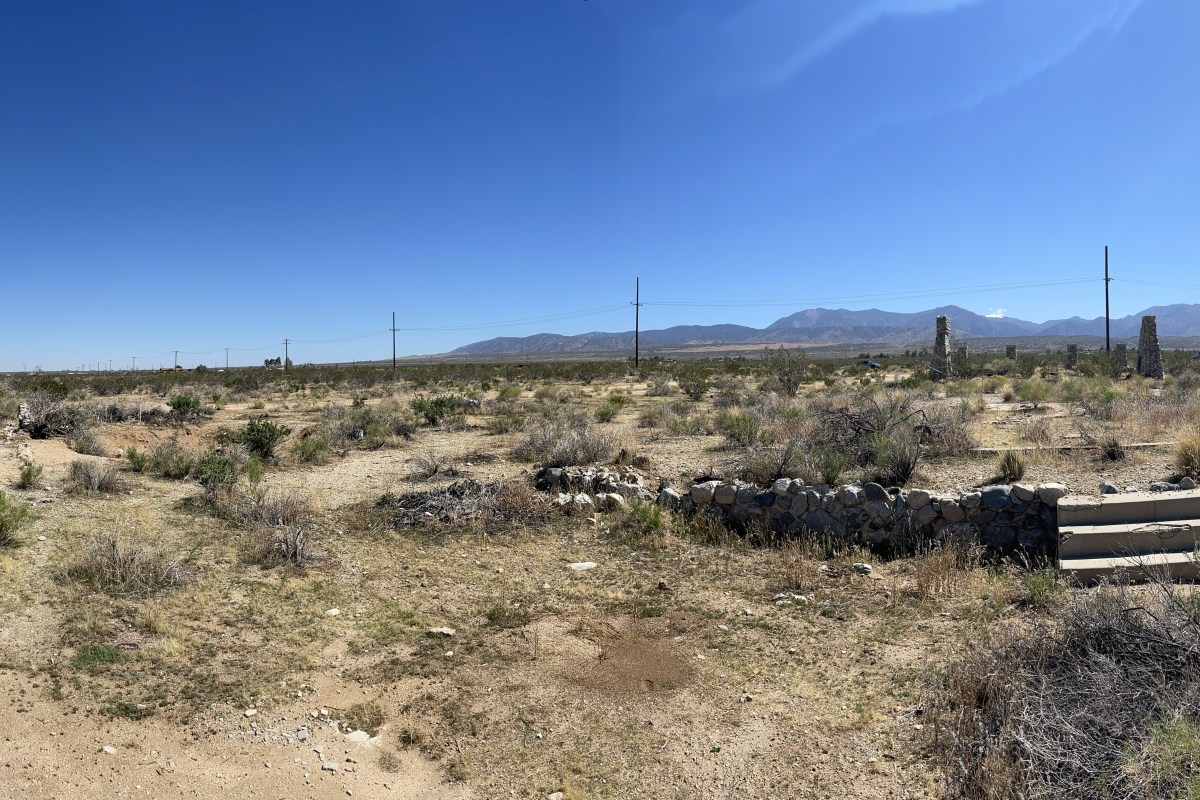
I am standing in the ruins of a utopian dream. Llano del Rio is sixty miles northeast of Los Angeles, splayed out under desert mountains. Founded in 1914, it was mostly dead by 1918, though a group of members—led by the founder Job Harriman—managed to limp forward for several years, moving to Louisiana before disbanding. To reach Llano today, you must drive through endless exurbs of the Antelope Valley, a utopia in the literal sense: a “not-place.” Thousands of houses, all the same, maliciously oblivious to the natural world, punctuated by churches that look like malls and malls that look like churches, all blended with the green-brown ground. Your speedometer will hit 101, and still the cars around you will blur by in some desperate bid to warp spacetime, to render the non-places nonexistent. No wonder that, among the Qdobas and Hobby Lobbys, mass shooters bloom; here, madness is the default state of being. Ecological madness, consumer madness, the madness of being from nowhere, not even the middle of nowhere. In older stories, the wanderer without a home always carries with him an air of danger.

In their violent self-similarity, these non-places speak to Marx’s elision of the future and Adorno’s insistence that positive utopias cannot be theorized. The exchange relationship is the essence of our world. Such an essence does not exclude thought. And so the equality of any utopia devolves into exchangeability, a liquidation of the unique subject in favor of the sameness of the commodity.

As Llano draws nearer, the dys-ou-topias, the bad-not-places of the exurbs thin out until suddenly they’re gone and only towns like Little Rock and Pearblossom remain.[1] You speed by church readerboards in Spanish, farmer’s markets that look like convenience stores, life-size dinosaurs made from rusted copper, tents where a family is serving up carne asada as roaring cars throw dirt on the grill, and signs—so many signs. Fresh local pears; land for sale; Charlie Brown Farms, breakfast specials!; McDonalds; land for sale; Autozone; for sale by owner; Family Dollar; Dollar General; Dollar Tree, every possible store with dollar in the name; Antelope Realty; John’s Automotive; Martin County state park; RV parking; more RV parking; Iglesia de Cristo Nuevo Empezar. And then even they disappear, with one exception. Realty advertisements continue right up to Llano, and then past it. 52% of California land is publicly owned. Driving through the Central Valley, you suspect the other 48% is listed.
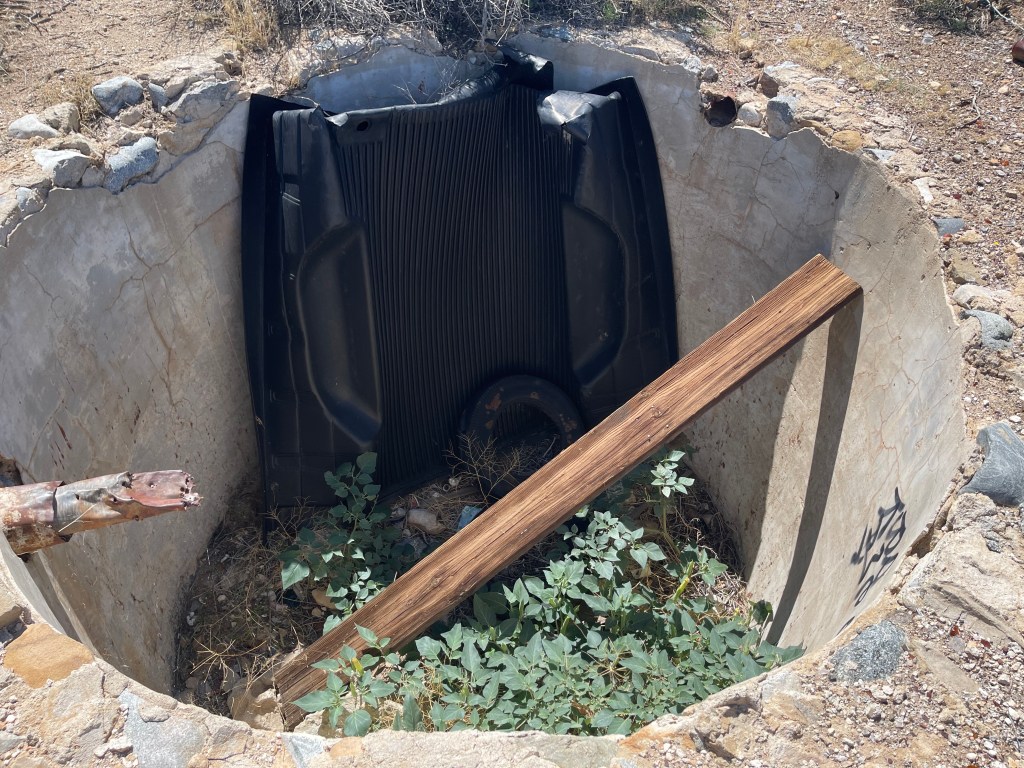
The GPS will direct you past the ruins of the cooperative; according to the maps, Llano is its post office. The city claims a population of 1,200, though they all seem to be in hiding. There’s a smattering of trailers and a few single-story ranch homes that might as well be trailers, and sand. Unimaginative graffiti covers the ruins closest to the highways and the remnants of the kiln. The ground is covered in broken beer bottles and corroded cans, a few so fully rusted I wondered if they were tins from the time of the cooperative.

It was probably already this desolate when Aldous Huxley first visited, writing “Llano del Rio: Ozymandias, The Utopia that Failed.” This would explain his antipathy for the project, despite his own utopian proclivities. He accused Job Harriman of ignoring nature in favor of abstract theory: “To the brute facts of meteorology in arid country Job Harriman was resolutely indifferent. When he thought of human affairs, he thought of them only as a Socialist, never as a naturalist.”[2] Later historians have emphasized that Huxley ignored the stress of anti-German xenophobia—this was the height of World War I—and anti-socialist broadsides from Otis Chandler’s LA Times. Not that it matters. A ruin is a ruin, however it became so.
And yet despite himself—and to his son’s bewilderment—Huxley was drawn to the decrepit monuments. He built a house there, brought his family up for extended periods. The bright desert sun allowed him to read, despite his near blindness. He spent the days typing in the heat. In the evenings, his wife Maria would read to him.[3] What drove him to this sandy no-place?
In his essay “Wordsworth in the Tropics,” Huxley writes:
Yes, the world is obviously one. But at the same time it is no less obviously diverse. For if the world were absolutely one, it would no longer be knowable, it would cease to exist. Thought must be divided against itself before it can come to any knowledge of itself. Absolute oneness is absolute nothingness: homogeneous perfection, as the Hindus perceived and courageously recognized, is equivalent to nonexistence, is nirvana.
For Huxley, utopia is non-existence. Standing in Llano, one feels that this very well might be the case . Swallowed by the ever-expanding desert on one side and the worn mountains on the other, you feel the exhilarating terror of our liquidation. No wonder teens come out here to drink, fuck, and smoke. Such thrills take on an added dimension in such a place. For David Foster Wallace, excess and intoxication are ways of dealing with terror.[4] Perhaps. But, paradoxically, these modes of escape, the temporary flights, are simultaneously attempts to experience nothingness. Drunk and high, the self feels as though it is on the way of being obliterated. In sex, one becomes part of another, the I becomes an us, or maybe a you. Intoxication as mimesis of the death drive, a cheap imitation of non-existence.
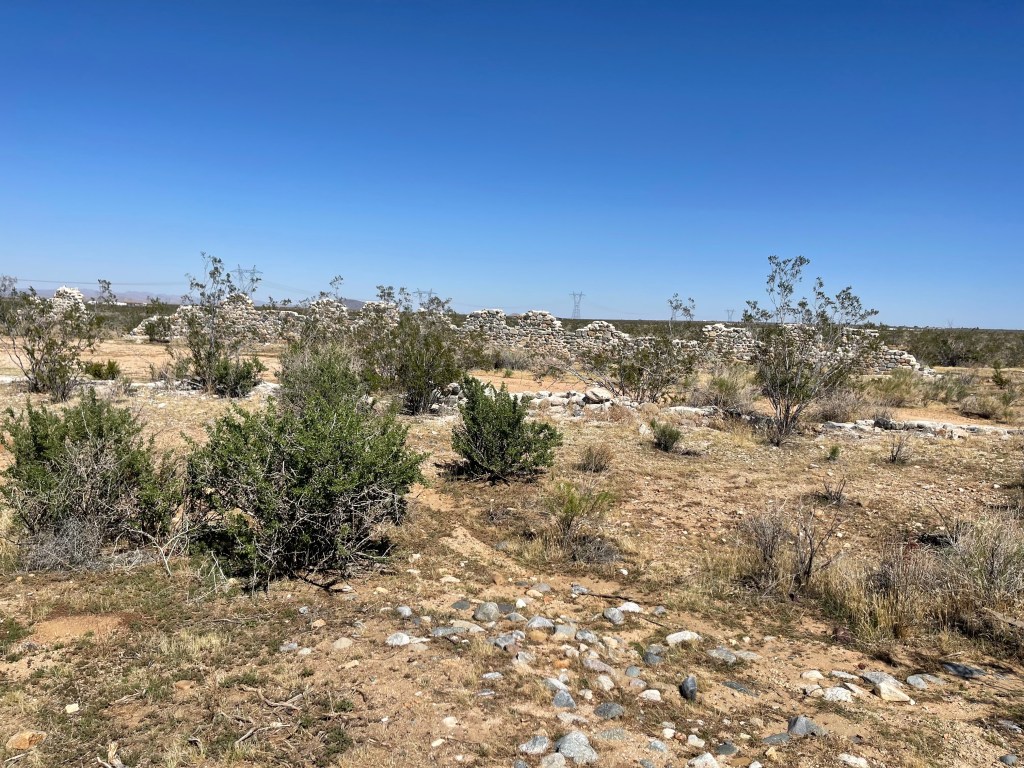
And then the stones rise from the ground, insisting on our existence, even as they—the stones—dream of going beyond this. They are a denkmal, a monument. Literally translated, it means “thought symbol/point/time” (mal can mean a symbol or point in time; einmal is “one time”). In its existence, a denkmal brings about thought, which requires the very difference it wishes to deny. This is true of the concept in general, and the rocks of Llano are no different. Thinking excises utopia, even as it requires utopia to exist. It is the failure of our world and the promise of a better one that drives philosophy. The monument differentiates a particular moment from all others. When we reflect on this object, this particular moment is then placed into relevance for our time, a different unique instant. Difference is obliterated, utopia achieved, only for it to slip away as the transposition fails, as the difference overcomes thought’s striving for non-existence.

Huxley eventually stopped going to Llano, preferring to stay in at his Malibu home—at least until it burned down. He laughed at the tragedy; for him, losing everything was good practice for dying. I will return to my car; it is 3:30 and I have six hours of driving to do. One can only sit with the paradox of thought for so long before fleeing. Huxley again: “It is fear of the labyrinthine flux and complexity of phenomena that has driven men to philosophy, to science, to theology—fear of the complex reality driving them to invent a simpler, more manageable, and, therefore, consoling fiction.” But these fictions are necessary. Even when they are wrong, perhaps especially then, they tell us about the world. Not only as it is, but as it may one day be. More than this, they save us from nonexistence. Driving through the exurbs, I thought of Llano.
[1] Of course they don’t actually disappear; the non-places are maintained in the shape of the chain stores and fast food restaurants. The philosophical term for this is aufhebung, when something is both eliminated and preserved.
[2] This is classic Huxley; for all his late mysticism, the Englishman’s only true faith was arithmetically determined limits on consumption.
[3] One imagines she was none too happy with this. In Los Angeles, she was carrying on “affairs”—in quotation marks because Huxley knew and didn’t care (indeed, they facilitated each other’s amorous relationships)—with Greta Garbo and other queer Hollywood stars. In Llano, she was babysitting a mostly blind man. That she loved him must have been cold comfort.
[4] “You think it’s a coincidence that it’s in college that most Americans do their most serious falling-down drinking and drugging and reckless driving and rampant fucking and mindless general Dionysian-type reveling? It’s not. They’re adolescents, and they’re terrified, and they’re dealing with their terror in a distinctively American way. Those naked boys hanging upside down out of their frat-house’s windows on Friday night are simply trying to get a few hours’ escape from the stuff that any decent college has forced them to think about all week.” Adolescence, we might note, is itself a developmental utopia. Neither child nor adult, the teenager begins reflecting on their existence exactly at said existence’s most tenuous. No wonder none of us escape unscathed.

 Miles Taylor